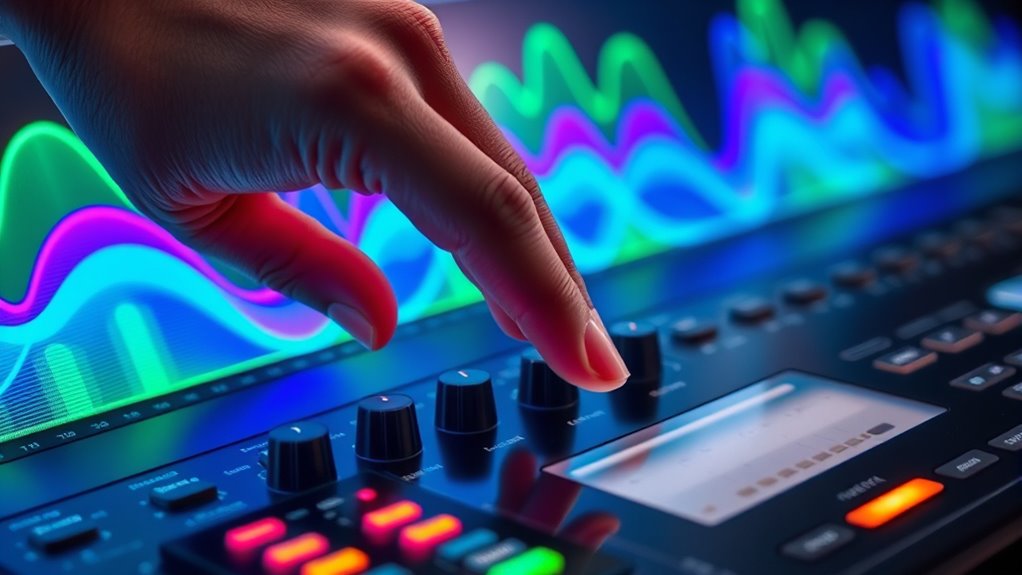

In wave programming, you can customize wave types and frequencies to craft unique soundscapes. Different waveforms like sine, square, and sawtooth have distinct characteristics that shape your audio experience. By selecting the right waveforms and fine-tuning their frequencies, you’ll achieve the desired textures for your sound design projects. Experimenting with these elements helps enhance the complexity and quality of your audio. There’s much more to explore when it comes to mastering these techniques.

Get sports gear delivered free with Prime
- Fast, free delivery on millions of items
- Prime Video, Amazon Music and more included
- Member-only deals all year
Key Takeaways
- Different waveforms like sine, square, triangle, and sawtooth offer distinct sound characteristics for customization in wave programming.
- Tailoring wave types and adjusting frequencies allows for achieving desired audio textures and effects in sound design.
- Experimentation with waveform combinations can generate innovative sounds and enhance the overall audio experience.
- Understanding modulation techniques enables dynamic adjustments of amplitude and frequency, significantly impacting sound quality and complexity.
- Balancing frequencies during customization ensures a cohesive and immersive audio output in music production and sound applications.
Wave Programming
Have you ever wondered how waves influence programming? Waves aren’t just for the ocean; they play a vital role in the world of sound and data processing. When you’re diving into wave programming, you’re fundamentally manipulating sound waves to create unique audio experiences. This involves practices like wave synthesis, where you generate sound waves from scratch or modify existing ones. Understanding how to control these waves can lead to innovative audio applications and creative sound design.
Waves shape our programming landscape, enabling the creation of innovative audio experiences through sound manipulation and synthesis.
As you explore wave synthesis, you’ll come across various techniques that help shape the sound. You can create different waveforms—sine, square, triangle, and sawtooth—each with distinct characteristics. By selecting the right waveform, you can achieve the sound texture you desire. In wave programming, customization is key. You want to tailor the wave types and frequencies to fit your project’s needs, whether it’s for music production, sound effects, or other audio applications.
Modulation techniques play a fundamental role in this process. These techniques allow you to alter different parameters of your waves, such as amplitude or frequency, over time. For instance, if you apply amplitude modulation, you can create dynamic soundscapes that evolve and fluctuate, capturing the listener’s attention. Frequency modulation, on the other hand, can result in rich harmonic textures that add depth to your compositions. Learning how to implement these modulation techniques effectively can elevate your programming skills and enhance your audio projects.
You might want to experiment with combining various waveforms and modulation techniques. This experimentation can lead to unexpected and exciting results. For example, layering multiple waveforms can generate complex sounds that are more interesting than a single wave alone. When you adjust the modulation parameters, you’ll find that even subtle changes can greatly affect the overall sound.
Moreover, wave programming isn’t limited to just creating sounds; it also involves understanding how these sounds interact with one another. By mastering wave synthesis and modulation techniques, you can develop a keen ear for sound design. You’ll learn how to balance frequencies and create harmony, ensuring your audio output feels cohesive. Additionally, understanding color accuracy can significantly enhance the quality of your audio visualizations, making them more immersive and engaging.
As an affiliate, we earn on qualifying purchases.
Frequently Asked Questions
What Tools Are Required for Wave Programming?
To get started with wave programming, you’ll need a digital audio workstation (DAW), a synthesizer, and an audio interface. You’ll want to familiarize yourself with oscillator settings to shape your sound effectively. Additionally, waveform synthesis tools will help you create and manipulate different waveforms. Don’t forget a MIDI controller for hands-on control, plus monitoring headphones or speakers to hear your results clearly. With these tools, you’ll be ready to explore sound design!
Can Wave Programming Be Used in Music Production?
Wave programming’s powerful potential plays a pivotal role in music production. By utilizing digital synthesis, you can craft mesmerizing sounds and diverse textures. You’ll discover that sound design becomes an exciting exploration, allowing you to manipulate waveforms to create unique musical experiences. Whether you’re layering lush pads or designing punchy basses, wave programming’s versatility enhances your tracks, making your music stand out. Immerse yourself and release your creativity!
How Do Different Wave Types Affect Sound Quality?
Different wave shapes markedly affect sound quality by altering how you perceive tones and harmonics. For instance, sine waves produce smooth, pure sounds, while square waves create a richer, more edgy tone. Frequency modulation can further enhance these effects, introducing complex variations that enrich your sound. By experimenting with various wave shapes and modulation techniques, you can craft unique, dynamic audio experiences tailored to your musical vision.
Is Wave Programming Suitable for Beginners?
Yes, wave programming is suitable for beginners! You’ll find that starting with wave basics makes it easier to grasp the concepts. Begin by experimenting with beginner techniques, like adjusting amplitude and frequency to hear how they affect sound. With practice, you’ll build confidence and understanding. Don’t hesitate to explore tutorials and resources—there’s a wealth of information to help you along the way. Jump in, and you’ll enjoy the creative process!
Are There Any Safety Concerns With Wave Programming?
Yes, there are safety concerns with wave programming. You need to be aware of wave safety to avoid programming hazards, such as equipment malfunctions or unintended frequencies. Always follow guidelines and use appropriate protective measures to minimize risks. It’s essential to understand how different wave types can impact your environment and maintain proper settings. By staying informed and cautious, you can effectively navigate these challenges while working with wave programming.
Conclusion
In the world of wave programming, customizing wave types and frequencies is as essential as a painter choosing their colors. By understanding the nuances of each wave, you can create a symphony of sound that resonates with your audience. So don’t hesitate to experiment and find the perfect combination that suits your needs. With practice, you’ll master the art of wave programming, turning your ideas into vibrant audio experiences that captivate and inspire.
Halloween Picks
halloween
As an affiliate, we earn on qualifying purchases.