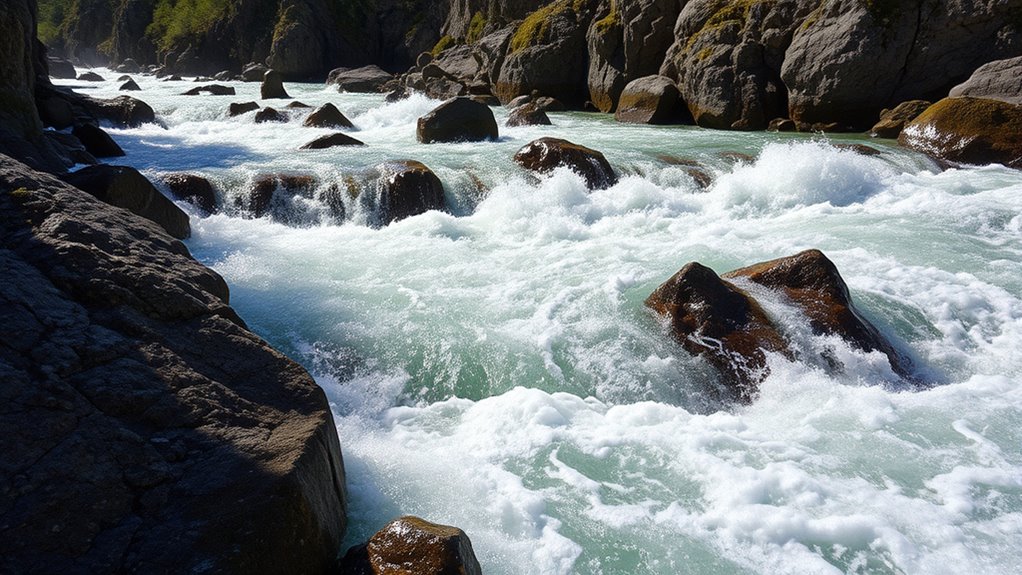

Whitewater classification grades are a visual system that helps you gauge river rapid difficulty and danger. They range from Class I, gentle flows, to Class VI, nearly impossible without expert skills. Recognizing these grades guides your route choices, safety gear, and hazard awareness. As the rapids increase in intensity, so does the need for proper preparation. Keep going to discover how these grades can help you paddle more confidently and safely.
Key Takeaways
- Visual guides illustrate the progression from Class I (easy) to Class VI (extremely dangerous) rapids, highlighting key features and obstacles.
- They use images and diagrams to depict rapid characteristics like drops, waves, and hazards at each grade level.
- A visual guide helps paddlers quickly assess river difficulty and match routes to their skill level.
- Such guides often include safety gear recommendations corresponding to each class of rapids.
- They assist in planning trips by visually identifying safe passages, danger zones, and technical features along the river.
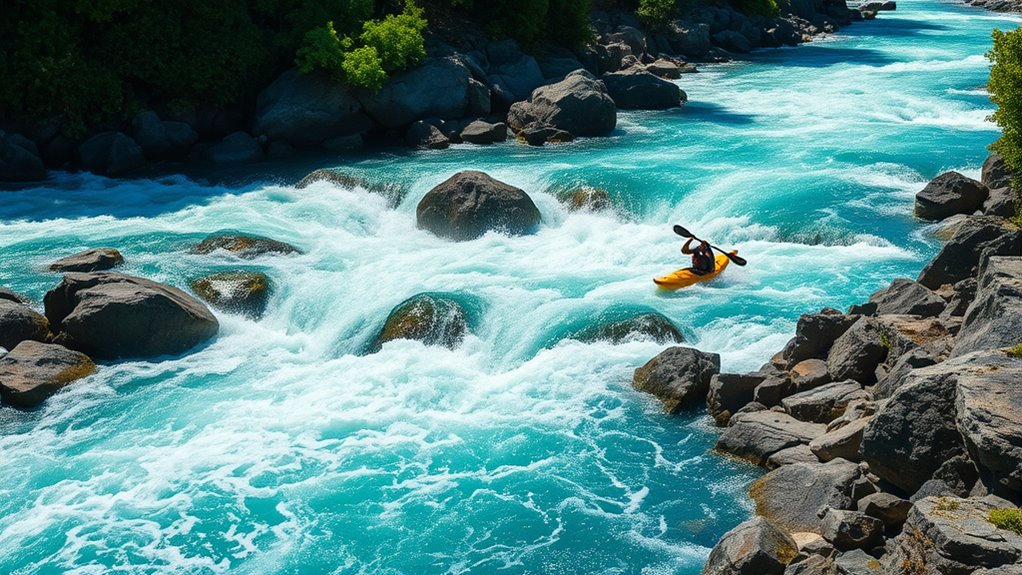
Whitewater classification grades provide a standardized way to measure the difficulty and danger of river rapids. When you’re planning a trip or steering through rapids, understanding these grades helps you assess risk and choose the right route. The grading system ranges from Class I, which features gentle, slow-moving water, to Class VI, indicating extremely dangerous rapids that are almost impossible to traverse safely. As you move up the scale, the rapids become more intense, with larger drops, powerful waves, and complex obstacles. Recognizing these grades allows you to prepare accordingly, especially when it comes to safety gear and river mapping. Color accuracy in your safety gear and equipment can also influence how well you respond in critical moments. Safety gear becomes even more critical as you venture into higher-class rapids. For lower grades, basic equipment like a personal flotation device (PFD) and a helmet may suffice, but as the difficulty increases, you’ll need more specialized gear. Helmets, sturdy paddles, wetsuits, and throw bags are essential for Class III and above. When dealing with Class IV and higher, having a well-fitted life jacket, protective clothing, and sometimes even a dry suit can make all the difference. Proper safety gear not only protects you but also boosts your confidence, enabling you to focus on steering the rapid rather than worrying about potential injuries. River mapping plays a pivotal role in understanding what lies ahead, especially when dealing with challenging grades. A detailed map highlights hazards like rocks, drops, and eddies, giving you a visual guide to plan your route more effectively. Before you hit the water, studying the river map helps you identify safe passage points and avoid dangerous areas. It also assists in estimating the difficulty of sections, which is key when deciding whether your skill level matches the rapids ahead. Knowing the layout of the river allows you to anticipate obstacles, adjust your paddling strategy, and ensure everyone in your group is prepared mentally and physically.
Frequently Asked Questions
What Safety Gear Is Recommended for Each Whitewater Grade?
When steering through different whitewater grades, you should always prioritize your kayak safety with appropriate gear. Wearing a well-fitted helmet is crucial, especially on challenging rapids, to protect against impacts. For beginner to intermediate levels, a personal flotation device (PFD) and appropriate footwear are essential. As you move to higher grades, consider additional safety equipment like throw ropes and protective clothing to stay safe and confident on the water.
How Do Water Levels Affect Classification Difficulty?
Water levels markedly impact classification difficulty by altering water flow dynamics and riverbed features. When water levels are high, rapids become more powerful and unpredictable, increasing the challenge. Conversely, lower levels reveal more riverbed features like rocks and drops, which can also raise difficulty if you’re not prepared. You need to constantly assess these changes to match your skill level and guarantee safety, adjusting your approach accordingly.
Are Certain Grades Suitable for Beginner Paddlers?
For beginners, lower-grade rapids are usually more suitable because calmer river flow lets you focus on basic paddling techniques. These easier sections help you build confidence and develop skills without overwhelming you. As you progress, you can tackle higher grades with more challenging currents and obstacles. Always assess your comfort level and practice proper paddling techniques to stay safe on the water, especially in more difficult whitewater.
How Can I Improve My Skills for Higher-Grade Rapids?
You need to bite the bullet and practice consistently. Focus on maintaining proper kayak posture and refining your paddle strokes to navigate higher-grade rapids confidently. As you gain experience, challenge yourself gradually and learn to read the water better. Remember, Rome wasn’t built in a day—improving your skills takes time, patience, and dedication. Keep pushing your limits and stay safe while mastering the techniques needed for more challenging whitewater.
What Rescue Techniques Are Essential for Each Grade?
When considering rescue techniques, you should focus on rescue boat deployment and self-rescue methods suitable for each grade. For lower grades, quick self-rescue and guiding others to safety work best. As you progress, learn to deploy rescue boats efficiently and assist others without risking yourself. Practice scenarios regularly so you can confidently respond under pressure, ensuring safety for everyone involved, regardless of rapid difficulty.
Conclusion
As you navigate the rushing waves and swirling currents, remember that whitewater grades guide your adventure. Picture yourself paddling through frothy, thunderous rapids, each grade revealing the thrill and challenge ahead. With this visual map in hand, you can confidently choose your path, feeling the spray on your face and the roar in your ears. Embrace the excitement, knowing your knowledge keeps you safe amid the exhilarating chaos of the river.