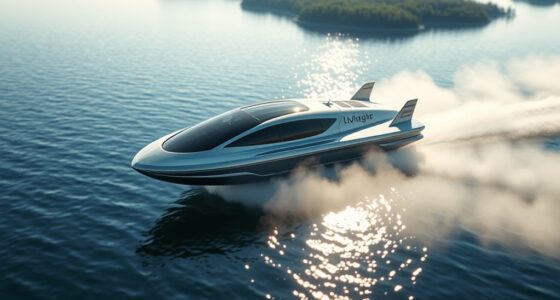
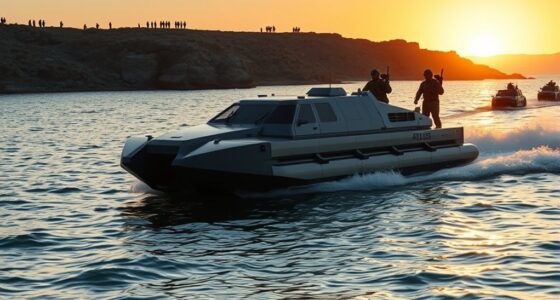
The history of hovercraft development spans from early 20th-century innovations to modern applications. It began with Gustave Trouvé’s electric hovercraft in 1870 and gained momentum in the 1950s with Christopher Cockerell’s practical prototypes. Military organizations quickly recognized their potential, leading to significant advancements during the Cold War. Today, hovercraft serve various roles, including ferry services and search and rescue missions, proving their versatility. There’s even more to uncover about their fascinating journey and impact.
Key Takeaways
- The hovercraft concept originated in the early 20th century, influenced by maritime innovations and military technology.
- In the 1950s, Christopher Cockerell developed a practical hovercraft prototype, utilizing air cushion technology for versatile terrain traversal.
- Military organizations invested heavily in hovercraft during the Cold War for rapid deployment and amphibious operations.
- Commercially, hovercraft became popular for ferry services in shallow waters and rough conditions, expanding transportation options.
- The legacy of hovercraft continues to influence vehicle engineering and transportation solutions, merging land and water capabilities.

Although hovercraft may seem like a modern invention, their development has roots that date back to the early 20th century. In fact, the concept of vehicles capable of gliding over water and land emerged from the intersection of maritime innovation and military technology. Early pioneers like Gustave Trouvé and his 1870 electric hovercraft model laid the groundwork for what would eventually evolve into the modern hovercraft. You might not realize it, but their designs were the first steps toward revolutionizing transport over challenging terrains.
Hovercraft, rooted in early 20th-century innovation, transformed transport by gliding effortlessly over land and water.
By the 1950s, researchers began to harness the principles of air cushion technology more effectively. You’ll find that this period marked a significant breakthrough, as British inventor Christopher Cockerell developed a practical hovercraft prototype. His design utilized a fan to create a cushion of air beneath the vehicle, allowing it to glide effortlessly over various surfaces. This innovative approach caught the attention of military organizations looking to enhance amphibious operations. Hovercraft could traverse both land and water, making them ideal for transporting troops and supplies across difficult environments.
During the Cold War, military technology further propelled hovercraft development. You might be surprised to learn that the U.S. Navy and British military invested heavily in these vehicles, recognizing their potential for rapid deployment and versatility. This military interest led to the creation of larger, more powerful models, which could carry heavy loads and operate in harsh conditions. As a result, hovercraft became invaluable assets for search and rescue operations, as well as for amphibious assault missions.
As the years progressed, commercial applications for hovercraft also began to emerge. You may have seen them used for ferry services in regions where traditional boats struggled with shallow waters or rough conditions. Their ability to glide over obstacles makes them suitable for various environments, from lakes to marshlands. The combination of speed and adaptability has made hovercraft a preferred choice in niche markets where conventional vehicles fall short.
Today, while hovercraft may not dominate the transportation landscape, their impact on maritime innovation and military technology remains significant. You can appreciate how their unique design has influenced various fields, paving the way for ongoing advancements in vehicle engineering. The legacy of hovercraft continues to shape the future of transportation, merging the domains of land and water in ways that once seemed impossible. Understanding motivation is crucial for innovators seeking to push boundaries in vehicle technology.
Frequently Asked Questions
What Are the Environmental Impacts of Hovercraft Operations?
Hovercraft operations can lead to environmental pollution and habitat disturbance. When you operate a hovercraft, the noise and wake can disrupt local wildlife and ecosystems. The air and water pollution from fuel emissions can affect the surrounding environment. Additionally, the hovercraft’s ability to travel over various terrains means it can inadvertently damage sensitive habitats, particularly in wetlands and coastal areas. It is important to take these impacts into account while using hovercraft in natural settings.
How Do Hovercraft Compare to Traditional Boats in Efficiency?
Hovercraft often outshine traditional boats in efficiency, especially when you consider fuel efficiency and operational costs. They glide smoothly over surfaces, reducing drag and allowing for quicker travel times. While traditional boats may struggle with resistance, hovercraft’s unique design enables them to navigate shallow waters with ease. You’ll find that their versatility can lead to lower maintenance costs, making them a delightful option for those seeking efficient aquatic transportation.
What Safety Measures Are Necessary for Hovercraft Use?
For hovercraft use, passenger safety is vital. Always guarantee everyone wears life jackets, especially in rough conditions. You should familiarize yourself with emergency protocols, including evacuation procedures and using safety equipment. Regularly inspect the hovercraft for mechanical issues and maintain communication devices for emergencies. It’s also wise to establish clear safety briefings for passengers before departure, so everyone knows what to do in case of an emergency. Stay prepared and prioritize safety!
Are There Any Hovercraft Regulations Specific to Certain Countries?
Absolutely, hovercraft regulations vary wildly across countries! You’ll find that some regions impose strict regulations, while others might be more lenient. In the U.S., for instance, hovercraft must comply with Coast Guard regulations, while the UK has its own set of regional regulations. Additionally, hovercraft operators should be aware of international standards that might apply, ensuring safety and environmental considerations are met wherever you go. Always check local laws before heading out!
What Future Advancements Are Expected in Hovercraft Technology?
Future advancements in hovercraft technology are exciting! You can expect innovative propulsion systems that enhance speed and efficiency, making hovercraft more versatile. Additionally, autonomous navigation is set to revolutionize how these vehicles operate, allowing for safer and more precise travel across various terrains. These improvements will not only increase operational capabilities but also make hovercraft a popular choice for both commercial and recreational use in the coming years.
Conclusion
In summary, hovercraft have come a long way since their inception, revolutionizing transportation across land and water. With applications ranging from military operations to eco-tourism, these versatile machines have truly made a mark. Imagine if Leonardo da Vinci had access to hovercraft technology—he’d have been zooming across lakes, sketching designs in mid-air! As we look to the future, the potential for hovercraft continues to expand, promising exciting innovations just around the corner.