TL;DR

Get sports gear delivered free with Prime
- Fast, free delivery on millions of items
- Prime Video, Amazon Music and more included
- Member-only deals all year
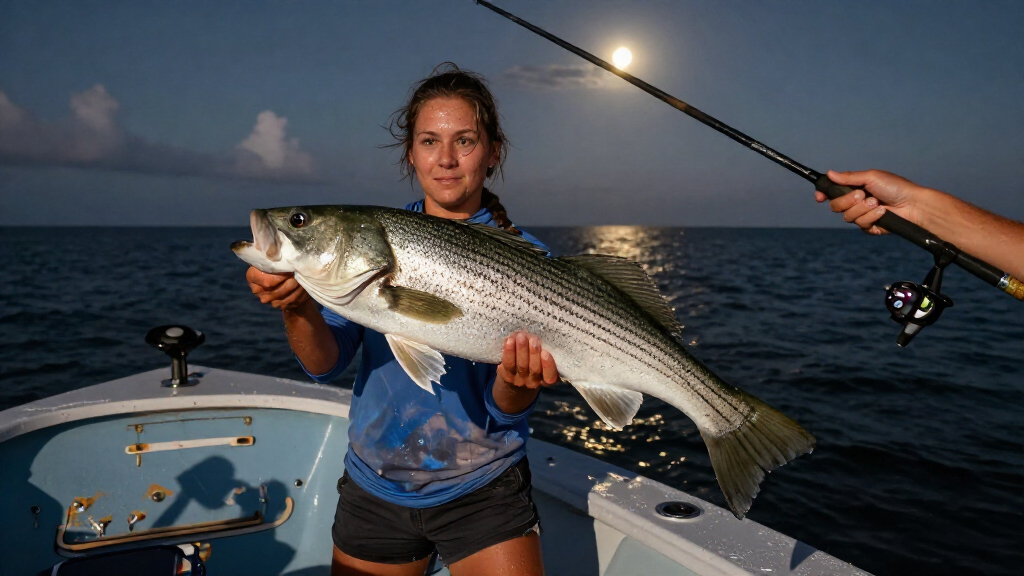
An Outdoor Life archive story recounts how its author caught a 76-pound striped bass off Montauk, New York, during a lunar eclipse on July 16, 1981. The source says the fish broke the all-tackle record at the time and describes the author fighting and landing it from his own boat, with a 13-year-old passenger asleep in the cabin.
An Outdoor Life archive story recounts how its author caught a 76-pound striped bass off Montauk, New York, during a lunar eclipse on July 16, 1981. The account says the fish broke the all-tackle record at the time and was fought and gaffed from the author’s 24-foot boat, largely without help.
The fishing trip began at 9:30 p.m. from Lake Montauk. The author was accompanied by 13-year-old Eddie Turpek, on his first nighttime bass trip, while friend John Alberda fished from a separate boat. They planned to drift live eels after hearing that large striped bass had been caught nearby the previous night. The author says the fishing was slow, despite marking bass on a recording depthfinder.
The account places the strike at about 3:30 a.m., while the eclipse was still in progress. After a bass took the eel, the author free-spooled the line, then struggled with a severe backlash and a burned thumb. The fish repeatedly ran line nearly to the knot, forcing him to work it closer to the boat by walking along the deck and retrieving line whenever its surges allowed.
When the fish finally came near, the author’s gaff grips slipped and the tool fell into the water. The supplied excerpt ends at that moment, before describing the final landing. Its introduction says the author ultimately landed and gaffed the fish single-handedly; the story identifies its weight as 76 pounds and says it set the all-tackle record at the time. The source does not provide independent record documentation in the material supplied here.
Outdoor Life Archive · Montauk, New York
I Caught The World-Record Striped Bass During The Eclipse Of A Full Moon
A first-person account recalls a 76-pound striped bass caught at 3:30 a.m. on July 16, 1981. The strike came during a lunar eclipse; the story does not show that the eclipse caused the fish to feed.
The archive story says the catch broke the all-tackle record at the time.
Strike reported while the lunar eclipse was still in progress.
A night drift off Long Island, fishing live eels near a deep ledge.
A night drift, then a long fight
The account moves from a slow search over the ledges to a demanding solo fight. These are the details reported in the archive story.
Live eels after dark
The anglers heard reports of large bass nearby and chose to drift eels. Friend John Alberda fished from a separate boat.
Bass on the depthfinder
Fishing was slow despite marks on the recording depthfinder. The author focused on ledges near the Great Eastern Buoy, around 40–50 feet deep.
A run toward the knot
After the eel was taken, free-spooling and a severe backlash made the first run harder to control; the line burned the author’s thumb.
From strike to gaff in five beats
The supplied excerpt captures the struggle up to the moment the gaff slips away.
A bass takes the live eel during the eclipse.
It pulls about 130 feet of line, nearly to a backlash knot.
The angler works along the deck, gaining line between surges.
A huge pale expanse appears near the boat.
The grips fail and the gaff falls into the water; the excerpt ends here.
What the 1981 account says was in use
Equipment details are historical reporting from the story, not current or universal fishing advice.
“The bass pulled out about 130 feet of line, right down to the knotty backlash.”The author, describing the first long run
Four moments from the telling
The excerpts convey the author’s anticipation, patience and surprise as the night unfolded.
“Somehow I knew that the full-moon night of July 16, 1981, was going to be special”
Before the trip got underway“I was marking bass on my recording depthfinder, and I was sure that they would turn on and feed sometime during the night.”
While the fishing was slow“The bass pulled out about 130 feet of line, right down to the knotty backlash.”
During the first run“There was such a huge expanse of white showing that she didn’t even look like a bass!”
As the fish neared the surfaceRecord claim & what remains unknown
The account’s claims and the supplied excerpt’s limits are both part of the story.
76 pounds · all-tackle record
The story says the fish broke the all-tackle record at the time and that the author landed and gaffed it single-handedly.
Official verification & landing sequence
No record-keeping body, weighing procedure or official record entry is included. The excerpt ends when the gaff falls into the water, before showing how the fish was brought aboard or weighed.
Key questions
What can be said from the archive material provided?
How much did the fish weigh?
The archive account identifies it as a 76-pound striped bass.
When and where was it caught?
About 3:30 a.m. on July 16, 1981, while fishing from Lake Montauk, at Long Island’s eastern end.
Did it set a world record?
The story says it broke the all-tackle record at the time. The supplied material does not include supporting documentation.
Did the eclipse make the bass bite?
The strike happened during the eclipse, but the account gives no evidence that the eclipse caused the fish to feed.
A Record Catch on a Night Drift
The account matters to fishing readers as a detailed first-person record of a major striped bass catch, including the conditions and gear involved. The fish’s reported 76-pound weight and the claim that it broke the all-tackle record place the episode in the sport’s record history, while the narrative shows how a prolonged fight can unfold when an angler is alone at the rod.
It also gives the eclipse a precise place in the story without establishing that it caused the catch. The author describes fishing around a full moon and an eclipse, but the account does not offer evidence that either celestial event changed bass behavior. The reported record and the fishing experience are the news; any connection between the eclipse and the fish biting remains an interpretation, not a demonstrated cause.
Products Worth Considering

Coleman Montana 8-Person Camping Tent with Rainfly

Garmin Tacx Boost Indoor Bike Trainer

Garmin Instinct 3 Solar Rugged GPS Smartwatch, 45 mm, Black
As an affiliate, we earn on qualifying purchases.
Montauk Fishing in July 1981
The trip took place at the eastern end of Long Island, where the author and Alberda had heard reports of large stripers caught by trolling the previous night. They chose to drift live eels instead, working areas near the end of the flood tide and then through the ebb. The author says bass were visible on his depthfinder but were not feeding early in the night.
His strategy focused on narrow ledges near the Great Eastern Buoy. He describes fish holding in specific areas along a drop from about 40 feet to 50 feet, where they could feed on bait moving over the ledge while avoiding the strongest current. The article also records the equipment he used: a conventional reel, a custom rod, 40-pound-test monofilament and a three-way swivel rig with a live eel. These are details from the 1981 account, not current fishing advice or a claim that the same setup is suitable in every situation.
“Somehow I knew that the full-moon night of July 16, 1981, was going to be special”
— The author, recalling the start of the trip
Record Verification and Landing Details
The supplied source describes the catch as a 76-pound fish that broke the all-tackle record at the time, but it does not name the record-keeping body, give a measurement or weighing procedure, or include a citation to an official record entry. The record claim is therefore attributable to the archive account on the information provided here.
The excerpt also cuts off just after the gaff falls into the water. Although its introduction says the author landed and gaffed the fish alone, this material does not show how he recovered from the dropped gaff, how the fish was brought aboard, or where and how its weight was recorded. It is also unclear from the supplied text whether Eddie woke or helped at any point. The account does not establish that the eclipse affected the fish’s feeding.
The Archive Account’s Final Moments
The next step for readers seeking the full sequence is to consult the complete Outdoor Life archive story, which may contain the missing landing details and any accompanying record documentation. The supplied material gives no current follow-up, new record filing or response from a record authority, so none can be reported here. The catch remains a historical account dated to July 1981, republished in an archive item dated Oct. 28, 2026.
Key Questions
How much did the striped bass weigh?
The archive account identifies the fish as weighing 76 pounds.
When and where was it caught?
The author says he caught it at about 3:30 a.m. on July 16, 1981, while fishing from Lake Montauk, at the eastern end of Long Island, New York.
Did the catch set a world record?
The archive story says the fish broke the all-tackle record at the time. The source material supplied here does not include the record authority or supporting documentation, so that claim is reported as the account’s description.
Did the lunar eclipse cause the fish to bite?
The story places the strike during the eclipse, but it provides no evidence that the eclipse caused the fish to feed. The timing is part of the account; a causal link is unestablished.
Source: outdoorlife.com