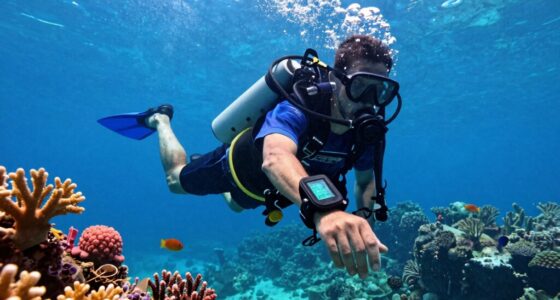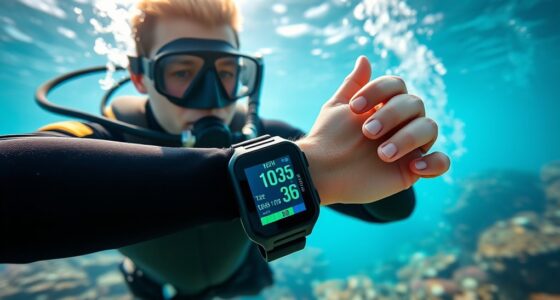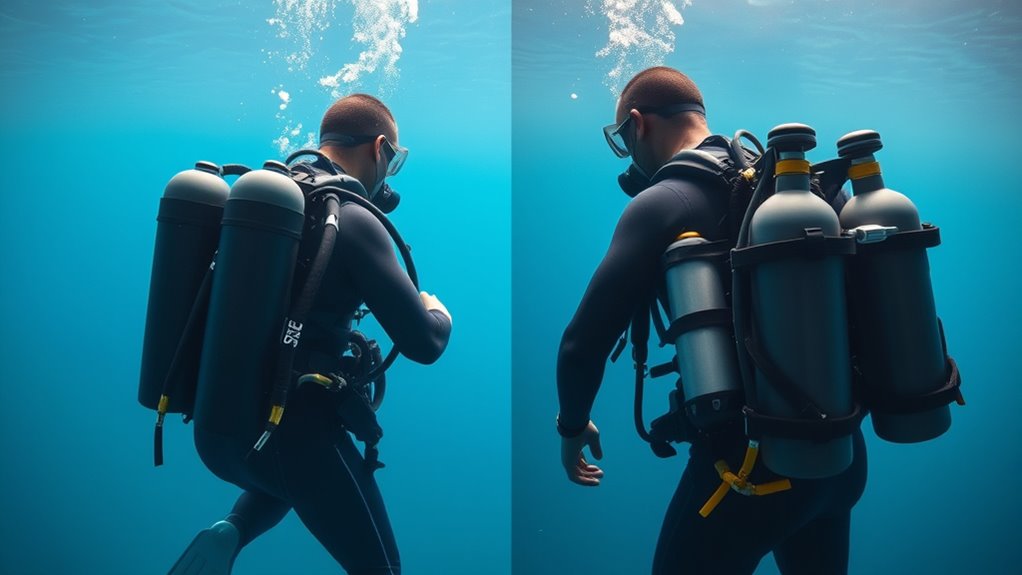

Choosing between sidemount and backmount depends on your diving environment and comfort. Sidemount offers greater flexibility, ideal for tight spaces, caves, and wrecks, giving you better maneuverability and reduced fatigue. Backmount provides stability and familiarity, suited for open water and deep dives. Your personal preferences and dive plans influence the best fit. To discover which setup suits you best and how to optimize your gear, keep exploring the details below.
Key Takeaways
- Sidemount offers greater flexibility and maneuverability in tight or complex environments like caves and wrecks.
- Backmount provides balanced weight distribution and stability, ideal for open water and deep dives.
- Sidemount enhances comfort and reduces fatigue by allowing customizable tank positioning.
- Backmount setup is familiar, easier to handle, and preferred for straightforward, open water diving.
- The choice depends on environment, dive type, and personal preference, with each configuration excelling in different scenarios.

When choosing between sidemount and backmount diving setups, understanding their differences can considerably impact your diving experience. Your decision affects how comfortable you feel underwater and how well the equipment suits the dive site you’re exploring. Sidemount gear, worn along your sides, offers a different experience from the traditional backmount configuration, which rests on your back. Both setups have their advantages, but knowing which to select depends on your comfort preferences and the dive environments you plan to encounter.
Equipment comfort is a major factor in choosing your setup. Sidemount diving typically provides greater freedom of movement, reducing strain on your shoulders and neck. Because the tanks are mounted along your sides, you can adjust their position for better balance and less fatigue during long dives. This can be especially beneficial if you have physical limitations or prefer a more streamlined profile. On the other hand, backmount setups tend to feel more familiar to many divers, with tanks secured on your back, distributing weight evenly and providing a sense of stability that some find reassuring. If you’re used to traditional diving gear, backmount might feel more natural, but sidemount often wins in terms of overall comfort during extended dives or technical dives that require multiple tanks.
Furthermore, dive site suitability plays a crucial role in determining the best configuration for your needs. Sidemount setups excel in tight or complex environments, such as caves, wrecks, or swim-throughs. Because the tanks are mounted lower and along your sides, sidemount gear offers increased maneuverability and less risk of snagging on overhead obstacles. This makes it a popular choice for cave diving or exploring narrow passages. Conversely, backmount configurations are generally better suited for open water sites, coral reefs, or deep dives where maximum stability and streamlined movement are desirable. Backmount tanks are easier to handle in open water, and many dive operators prefer this setup for its simplicity and familiarity. However, if your dive site involves confined spaces or intricate topography, sidemount’s flexibility and reduced bulk can make a noticeable difference.
Ultimately, your choice depends on your comfort level, the dive environment, and your specific training. Sidemount gear can transform your diving experience by offering more comfort and agility in challenging settings, while backmount gear provides stability and ease of use in more open, straightforward sites. Both setups have their merits, but understanding how each aligns with your needs will help you make the best decision for safer, more enjoyable dives.

xdeep Stealth 2.0 TEC Sidemount Scuba Diving BCD
Ideal for beginners and experienced sidemount divers alike, created for open water, wreck and cave diving
As an affiliate, we earn on qualifying purchases.
As an affiliate, we earn on qualifying purchases.
Frequently Asked Questions
Which Configuration Is Better for Technical Diving?
When choosing the best configuration for technical diving, consider your needs for equipment flexibility and training requirements. Sidemount setups often offer easier access to gear, streamline movement, and adapt to various environments, making them ideal for complex dives. Backmount rigs provide stability and familiarity if you’re trained with traditional setups. Your choice depends on your comfort level, training, and the types of dives you plan, ensuring safety and efficiency underwater.
How Do Cost Differences Impact Beginner Divers?
When considering diving gear, cost differences can influence your choices as a beginner diver. Equipment costs vary, and you might find sidemount setups more expensive initially due to additional gear and accessories. These upfront costs could impact your budget, but investing in quality gear guarantees safety and comfort. You should weigh the long-term benefits against the initial expenses, understanding that the right equipment supports your learning and future diving adventures.
Can Divers Switch Easily Between Configurations?
Switching between configurations is like changing gears on a busy road—you need to be smooth and confident. It’s not always a simple flip; gear compatibility and training requirements play essential roles. You’ll need proper instruction and practice to adapt safely. While some divers find it seamless, others may face a learning curve. With dedicated training, you can become versatile, mastering both setups for different diving adventures.
What Are the Safety Concerns for Each Setup?
When considering safety concerns, you should be aware of gear compatibility and emergency procedures for each setup. In sidemount, verify your cylinders and gear are properly secured to prevent accidents, and practice emergency procedures like regulator recovery. For backmount, check that your harness and buoyancy control are secure, and rehearse emergency ascents. Both configurations demand proper training to handle potential issues and ensure safe dives.
Are There Specific Diving Environments Suited to Each?
Like a key fitting perfectly into its lock, your diving setup should match your environment. Sidemount gear excels in tight spaces like cave diving and wreck exploration, offering flexibility and streamlined movement. Backmount setups are ideal for open water, providing stability and a more traditional profile. Choose your configuration based on the environment’s demands, ensuring you feel confident and secure whether exploring underwater caves or wrecks.

urbanhouse BAIE 2-Tank Scuba Diving Cylinder Tank Rack with Carrying Handle
[Protected & Secure] – Each rack comes equipped with three ultra-dense foam tubes that protect tank surfaces while…
As an affiliate, we earn on qualifying purchases.
As an affiliate, we earn on qualifying purchases.
Conclusion
So, whether you choose sidemount or backmount, remember this: you’re not just picking a configuration, you’re revealing the ultimate underwater superpower! With sidemount’s agility or backmount’s stability, you could conquer the depths like a legendary explorer. The debate’s settled, but your dive style is about to become legendary. So go ahead, pick your gear, and prepare to plunge into the ocean’s mysteries like a hero destined for greatness!

Custom Kraze Cave Diving Warning Reproduction Metal Sign 8 x 12
EYE CATCHING 12 inches high X 8 inches wide – designed to get the message across and to…
As an affiliate, we earn on qualifying purchases.
As an affiliate, we earn on qualifying purchases.

Cressi AC2 / Compact + Octopus Compact Complete Regulator Set, Black/Yellow, INT
This regulator is made up of the new 2nd stage XS Compact with elastomer cover combined comes with…
As an affiliate, we earn on qualifying purchases.
As an affiliate, we earn on qualifying purchases.