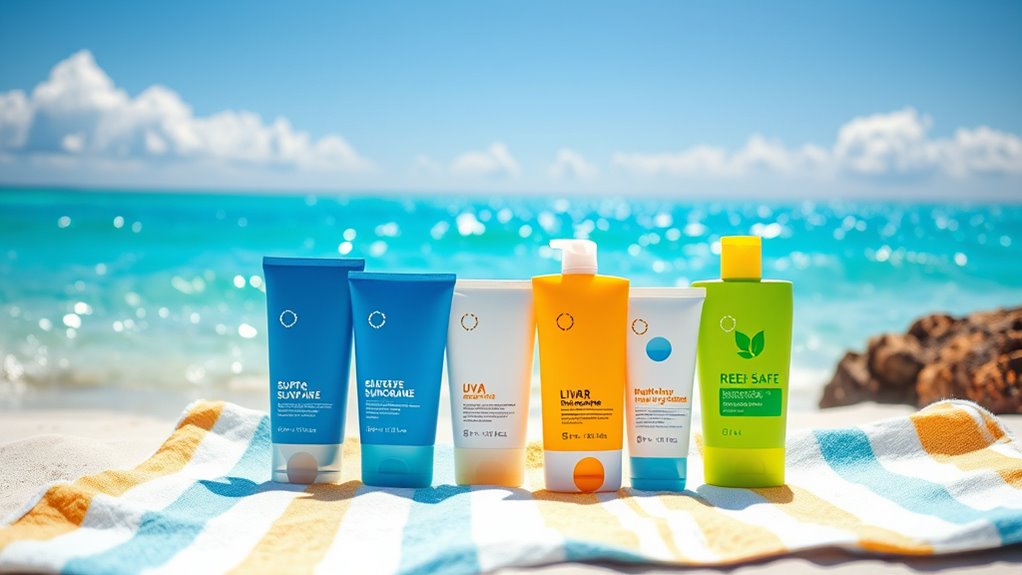

Sunscreen protects you from harmful UVA and UVB rays, which can cause premature aging and increase your cancer risk. To safeguard your skin, choose broad-spectrum formulas with physical blockers like zinc oxide or titanium dioxide. These ingredients scatter harmful rays and are safer for marine life, unlike chemical options that can harm coral reefs. Remember, proper application and reapplication is key. There’s a lot more to discover about maximizing your sun protection and protecting the environment.
Key Takeaways
- Sunscreen protects against UVA rays, which cause premature aging, and UVB rays, which lead to sunburn and increased skin cancer risk.
- Broad-spectrum formulas are essential for comprehensive protection against both UVA and UVB rays.
- Mineral-based sunscreens with zinc oxide and titanium dioxide are safer for marine ecosystems and prevent coral bleaching.
- Choose reef-safe options to minimize environmental impact while ensuring effective UV protection.
- Proper application and reapplication of sunscreen are crucial for maintaining skin protection regardless of SPF level.

Have you ever wondered how sunscreen really protects your skin? It’s vital to understand the science behind it, especially with all the options available today. Sunscreen works primarily by providing UV protection, preventing both UVA and UVB rays from penetrating your skin. UVA rays are responsible for premature aging and wrinkles, while UVB rays can cause sunburn and increase your risk of skin cancer. By applying sunscreen, you’re creating a barrier that absorbs or reflects these harmful rays, allowing you to enjoy the sun while minimizing damage.
When choosing a sunscreen, you’ll want to pay attention to ingredient safety. Not all sunscreens are created equal, and some contain chemicals that can be harmful not only to your skin but also to the environment. Look for broad-spectrum formulas that protect against both UVA and UVB rays. Ingredients like zinc oxide and titanium dioxide are physical blockers that provide effective UV protection without the potential toxicity of some chemical alternatives. These minerals sit on the skin’s surface and scatter harmful rays, making them a safer choice for both your body and the planet.
You might be surprised to learn that some sunscreens can harm marine life. Certain chemical ingredients, such as oxybenzone and octinoxate, have been shown to contribute to coral bleaching. If you’re concerned about the environment, consider opting for reef-safe sunscreens that use safer, mineral-based ingredients. Not only is this better for aquatic ecosystems, but it also aligns with a growing awareness of ingredient safety.
Applying sunscreen isn’t just about slathering it on before hitting the beach. You’ve got to choose the right SPF, apply it generously, and reapply every two hours, especially after swimming or sweating. Many people think that a higher SPF means better protection, but it’s more about the application technique than the number itself. An SPF of 30 blocks about 97% of UVB rays, while SPF 50 blocks about 98%. The difference isn’t as significant as you might think, which is why consistent application is key.

Fender x Wavestorm Collaboration 8ft Surfboard | Graphic top Deck with high Density Slick Bottom | for Kids and Adults | Foam Construction with Accessories | Leg Leash and Fin Set Included
The Wavestorm 8ft surfboard dimensions are 96 l x 22.5" w x 3.25" thick - weight is 11.4lbs...
As an affiliate, we earn on qualifying purchases.
Frequently Asked Questions
How Often Should I Reapply Sunscreen During Outdoor Activities?
You should reapply sunscreen every two hours during outdoor activities, especially if you’re sweating or swimming. If you’re exposed to intense sun, consider applying it more frequently. Remember, a good application initially is key, but regular reapplication is vital to maintain protection. Don’t forget to cover all areas, including often-missed spots like ears and feet, to guarantee you’re well-protected against harmful sun exposure throughout your time outside.
Can I Use Expired Sunscreen Safely?
You shouldn’t use expired sunscreen, as it can lose its effectiveness. Studies show that SPF can drop considerably after its expiration date, leaving your skin vulnerable to UV damage. Proper sunscreen storage is key; keep it in a cool, dry place to maintain its potency. If you find an old bottle, check for changes in color, texture, or smell. When in doubt, it’s safer to toss it and get a new one.
Are Spray Sunscreens as Effective as Lotion?
Yes, spray sunscreens can be as effective as lotion, but application consistency is key. You’ve gotta make certain you apply enough product and cover all areas thoroughly. Lotions often provide better control, so you might find them easier to use for even coverage. However, if you’re diligent with your spray technique and reapply regularly, you can achieve great protection. Just remember, both options need proper usage for maximum effectiveness!
What’s the Difference Between Chemical and Physical Sunscreens?
When it comes to sunscreen, you’ve got to know your stuff. Chemical sunscreens use filters that absorb UV rays, turning them into heat, while physical sunscreens act like a shield, reflecting UV rays with physical blockers like zinc oxide or titanium dioxide. If you’re looking for something that sits on your skin and starts working right away, physical might be your best bet. Otherwise, chemical options can blend in smoothly and feel lighter.
Do Sunscreens Expire, and How Can I Tell?
Yes, sunscreens do expire. You can usually tell by checking the expiration date printed on the bottle. If it’s past that date, don’t use it. Additionally, pay attention to changes in color, consistency, or smell—these are key expiration indicators. To guarantee your sunscreen lasts longer, store it in a cool, dry place away from direct sunlight. Proper sunscreen storage can help maintain its effectiveness until you’re ready to use it.

Ho Stevie! Surfboard Car Racks - Padded System, Easy Setup Any Car, ‘No Scratch’ Buckles - Strap Up to 3 Boards to Car Roof
🏄♂️ HOLDS UP TO 3 SURFBOARDS - Can be used with or without surfboard bags or surfboard socks...
As an affiliate, we earn on qualifying purchases.
Conclusion
In the quest for healthy skin and a thriving ocean, choosing the right sunscreen is essential. By understanding the differences between UVA and UVB rays, you can protect yourself while also being mindful of the environment. Opting for reef-safe options isn’t just a trend; it’s a monumental step towards preserving our planet’s beauty. So, slather on that sunscreen and bask in the sun—your skin and the ocean will thank you for it!

Pro-Lite Finless Coffin Surfboard Travel Bag Double/Triple (2-3 Boards) 7'6
This boardbag has 10mm of foam protection and is designed for the traveling surfer taking 2-3 boards depending...
As an affiliate, we earn on qualifying purchases.

OCEANBROAD Surfboard Longboard Travel Bag Double for 2 Boards 6'0, 6'6, 7'0, 7'6, 8'0, 8'6, 9'0, 9'6, 10'0
BAG SIZE WEIGHT AND SHAPE: 6’6’’ x 22’’ x 6'', 10.5 lbs, for board size up to 6’8’’...
As an affiliate, we earn on qualifying purchases.