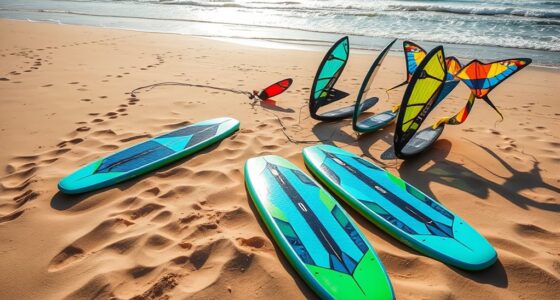
To master advanced kitefoiling, focus on smooth tacks and jibes. Keep your kite high for lift as you approach turns, and shift your weight to your back foot. Engage your core for stability during maneuvers. For jibes, move the kite forward and switch your feet as you maintain speed and balance. Anticipate wind shifts and adjust your kite positioning for seamless conversions. Stick around to uncover more tips and techniques to enhance your kitefoiling skills.

Get sports gear delivered free — and shop member deals
- Fast, free delivery on millions of items
- Access to Prime Big Deal Days deals on October 6–7
- Prime Video, Amazon Music and more included
Key Takeaways
- Maintain speed and kite height while approaching tacks for optimal lift and control during the turn.
- Shift weight to the back foot and engage core muscles for stability during tack execution.
- In jibes, initiate the turn by moving the kite forward and smoothly switch foot positioning.
- Anticipate wind behavior and adjust kite positioning to enhance transition fluidity and stability.
- Regular practice helps develop intuitive movements and improves overall performance in advanced kitefoiling techniques.

Kitefoiling offers an exhilarating blend of speed and grace, and mastering the right techniques can elevate your experience on the water. Among these techniques, advanced maneuvers like tacks, jibes, and progressions can considerably enhance your overall performance. To nail these moves, you’ll need to focus on foil control and wind adjustments, which are essential for smooth and controlled navigation.
Starting with tacks, you’ll want to approach the turn with a bit of speed while keeping your kite positioned high in the wind window. This helps provide lift and maintains momentum as you initiate the turn. As you lean into the turn, shift your weight to the back foot to keep that foil from sinking. Engaging your core will help you maintain balance while you steer the kite across the wind. Remember, it’s all about fine-tuning your foil control. If you feel the foil start to dip, a slight adjustment in weight distribution can help you regain that lift.
When it comes to jibes, the key is in the timing and the kite’s positioning. As you start your turn, move your kite forward and down a bit, allowing the foil to glide smoothly through the transition. You’ll want to initiate the turn with your back foot while keeping the front foot light. This helps you maintain speed and stability. As you switch your feet, be mindful of wind adjustments; the more you practice, the better you’ll become at reading the wind’s behavior and responding accordingly. If you can anticipate shifts in wind direction, you’ll have a much easier time executing a seamless jibe.
Progressions are another essential skill to master, especially if you want to maintain a fluid style. As you approach a progression, keep your kite high and your body relaxed. The goal is to keep the foil flying and not let it drop. Lean back slightly as you pivot, shifting your weight smoothly from one foot to the other. Here, foil control plays a critical role; the more you practice, the more intuitive these movements will become.
Incorporating these advanced techniques into your kitefoiling repertoire will not only boost your confidence but also enhance your overall experience on the water. So, get out there, embrace the wind adjustments, and enjoy the thrill of mastering tacks, jibes, and progressions. Each session will bring you closer to becoming the rider you aspire to be.
As an affiliate, we earn on qualifying purchases.
Frequently Asked Questions
What Equipment Is Best for Advanced Kitefoiling?
For advanced kitefoiling, you’ll want high-performance gear that enhances your skills. Look for a foil design that balances lift and stability, allowing you to focus on mastering control techniques. A larger wing offers better lift, while a smaller one promotes speed and maneuverability. Pair your foil with a responsive kite that suits your wind conditions and provides precision control. This combination will elevate your kitefoiling experience markedly.
How Do I Improve My Kitefoiling Fitness?
Improving your kitefoiling fitness is like tuning a race car; precision matters. Focus on building core strength and endurance through exercises like planks and Russian twists. Incorporate cardio workouts, like cycling or running, to boost your stamina. Consistency is key, so set a routine that challenges you. Don’t forget to balance strength training with flexibility exercises to enhance your overall performance on the water. You’ll feel the difference in no time!
Can I Kitefoil in Light Wind Conditions?
Yes, you can kitefoil in light wind conditions! To maximize your experience, focus on light wind techniques, like using a larger kite and maintaining a smooth, steady edge. Equipment optimization is key—ensure your board is appropriate for low wind, and keep your lines and kite in top condition. Practice patience and timing, as these elements will help you glide effortlessly across the water, even when the breeze is gentle. Enjoy the ride!
What Safety Gear Is Recommended for Kitefoiling?
When you venture into the vast ocean, think of your safety gear as your trusty armor. You’ll want a helmet to guard your head, impact vest for your torso, and a wetsuit for warmth. Don’t forget a leash for your kite and a quick-release system, making emergency procedures smoother. These protective gear essentials will keep you safe while you navigate the waves, ensuring your adventure remains thrilling, not perilous.
How Do Weather Conditions Affect Kitefoiling Performance?
Weather conditions greatly impact your kitefoiling performance. Strong wind patterns can give you speed and lift, but gusty winds can make control tricky. You need to adjust your technique accordingly. Water currents also play a vital role; they can either assist you in moving faster or slow you down, depending on their direction. Keeping an eye on both wind and currents ensures you make the most of every session on the water.
Conclusion
Mastering advanced kitefoiling techniques like tacks, jibes, and evolutions can feel like dancing on water. As you practice these maneuvers, you’ll find your confidence soaring, just like your kite in the wind. Remember, the key is to stay relaxed and fluid, letting your body move with the rhythm of the waves. Keep pushing your limits, and soon you’ll be gliding through the water with grace and style, leaving your worries behind like footprints in the sand.
Halloween Picks
halloween
As an affiliate, we earn on qualifying purchases.