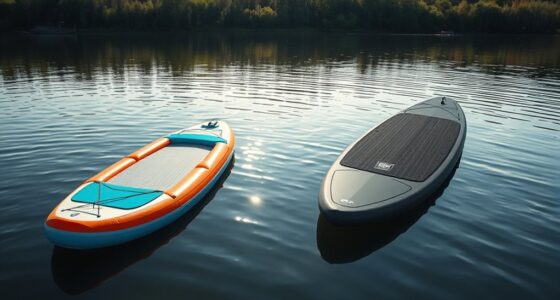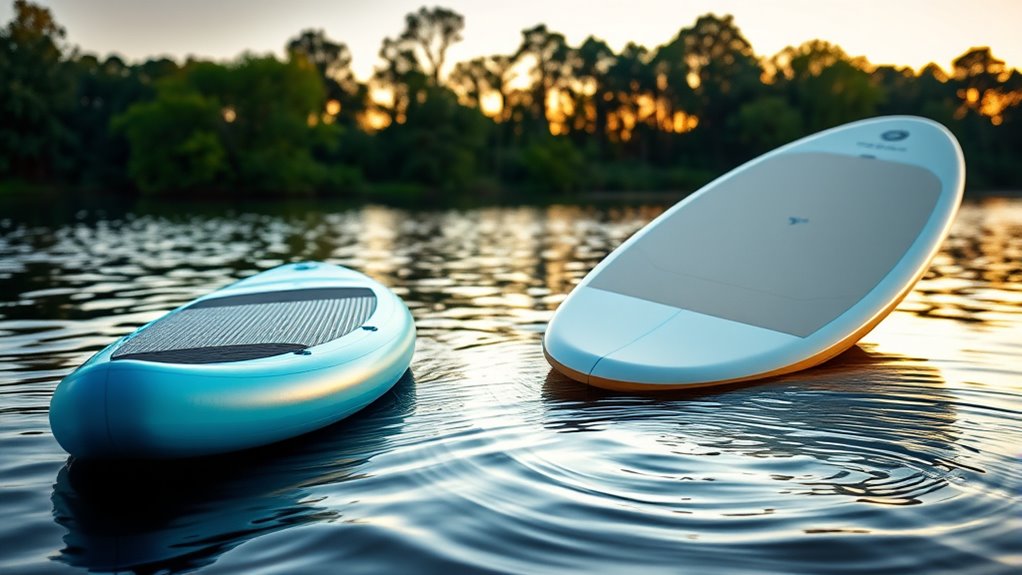

When choosing between inflatable and hard SUP boards, consider your needs. Inflatable boards are portable, easy to store, and perfect for casual paddlers. They require setup time and may offer less stability. Hard boards, on the other hand, deliver superior performance and stability but are bulkier, needing more storage space. If you’re looking for convenience and travel-friendly options, inflatables are great. For serious racing and surfing, hard boards shine. Stick around to explore more about what suits you best!
Key Takeaways
- Inflatable SUP boards are portable and easy to store, making them ideal for travelers and those with limited space.
- Hard SUP boards offer immediate use without setup time, catering to spontaneous paddlers.
- Performance-wise, hard boards provide better stability and are preferred for racing and surfing in rough waters.
- Inflatable boards require inflation but are versatile for casual paddling and can support various water activities.
- Storage of hard boards requires more space, while inflatables can fit in small areas like closets.
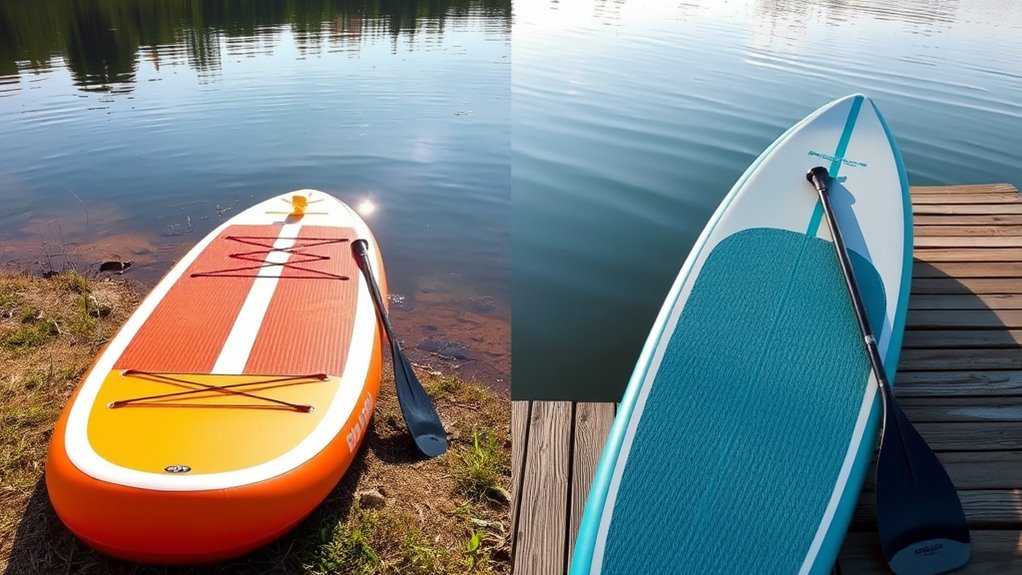
When you’re choosing between inflatable and hard SUP boards, it’s essential to take into account your specific needs and preferences. One of the most significant factors to consider is how you’ll be transporting and storing your board. Inflatable SUP boards shine in terms of transportation ease and storage space. They can be deflated and rolled up to fit into a compact bag, making them incredibly portable. If you often find yourself traveling to different locations or lack sufficient storage at home, an inflatable board could be your best bet. You can easily toss it in the trunk of your car or even take it on a plane without worrying about excess baggage fees.
Choosing between inflatable and hard SUP boards hinges on your transport and storage needs, with inflatable boards offering unmatched portability.
On the other hand, hard SUP boards tend to be bulkier and take up more space. While they offer enhanced performance on the water, transporting them can be a hassle. You’ll need a roof rack or a large vehicle to haul them around, which might not be feasible for everyone. If you live in a small apartment or have limited garage space, the rigid design of a hard board could become a significant obstacle. You might find that finding a suitable spot to store it becomes a challenge, whereas inflatable boards can be tucked away in a closet or under a bed when not in use.
Another consideration is the time and effort involved in setting up your board. Inflatable SUP boards require a bit of preparation before you hit the water. You’ll need to inflate the board, which can take anywhere from a few minutes to about half an hour, depending on the pump and your experience. Hard boards, on the other hand, are ready to go right away, so if you value convenience and quick access, this is a point in their favor.
However, both options have their trade-offs. While inflatable boards are great for casual paddlers and those who prioritize convenience, hard boards tend to offer better stability and performance, especially in rough waters. If you’re aiming for high-speed racing or surfing, you might lean toward a hard board despite the transportation and storage challenges. Additionally, many water sports enthusiasts choose to engage in activities like snorkeling and diving, which can complement their SUP adventures.
Ultimately, the choice between inflatable and hard SUP boards boils down to what matters most to you: convenience and portability or performance and stability.

Inflatable Life-Jacket for Adults| Life-Vest with Automatic/Manual Multifunctional Inflation-PFD| Lightweight & Compact Supports up to 300lbs for Kayaking Fishing Boating (Camouflage)
Inflatable Life-Jackets: Lightweight & Comfortable, Weighs 1.2lbs and features a compact, low-profile design. With a fully adjustable waist...
As an affiliate, we earn on qualifying purchases.
Frequently Asked Questions
Can I Use an Inflatable SUP in Rough Waters?
Yes, you can use an inflatable SUP in rough waters, but you need to adjust your paddling techniques. In choppy wave conditions, maintain a low center of gravity and keep your stance wide for better stability. Use strong, controlled strokes to navigate through the waves. While inflatable boards can handle some roughness, be cautious and aware of your skill level, as conditions can quickly become challenging. Always prioritize your safety on the water.
How Do I Store My Hard SUP Board?
To store your hard SUP board, start by cleaning it thoroughly to remove dirt and salt. Keep it in a cool, dry place away from direct sunlight to prevent damage to the board material. Use storage techniques like a padded rack or wall-mounted hooks to prevent warping. Avoid stacking other boards on top of it, as this can cause pressure points. Proper storage guarantees your board stays in great shape for your next adventure.
Are Inflatable SUP Boards Suitable for Yoga?
Imagine a serene lake, where a gentle breeze whispers tranquility. Inflatable SUP boards are indeed suitable for yoga, offering a unique blend of comfort and stability. With their softer surface, you can find your balance more easily, allowing you to focus on your poses without worrying about hard edges. While practicing your sun salutation, you’ll appreciate the cushiony feel, creating an environment where yoga flows as smoothly as the water beneath you.
What Is the Lifespan of an Inflatable SUP?
An inflatable SUP typically lasts between 5 to 10 years, depending on its maintenance and usage. Durability concerns often arise from punctures or wear from UV exposure, so it’s essential to store it properly. The material longevity can vary based on the quality of the construction; opting for higher-quality materials can extend its lifespan markedly. Regularly inspecting for damage and taking care of repairs will also help you maximize its use.
Can I Repair a Punctured Inflatable SUP?
Yes, you can repair a punctured inflatable SUP. For effective board maintenance, first locate the puncture and clean the area. Use a suitable repair kit, applying adhesive and a patch over the hole. guarantee proper inflation techniques are followed during the repair process, letting it cure fully before reinflating. Regular checks and timely repairs will keep your board in great shape, ready for your next adventure on the water!

Onyx A/M-24 Automatic/Manual Inflatable Life Jacket, U.S. Coast Guard Approved, Low Profile, Compact Design, Manual Convertible Inflation Option
U.S. COAST GUARD APPROVED: This USCG-approved Inflatable Life Jacket inflates automatically upon water immersion or manually pulling the...
As an affiliate, we earn on qualifying purchases.
Conclusion
When it comes to choosing between inflatable and hard SUP boards, it really boils down to your needs and preferences. Remember, “different strokes for different folks.” If you value portability and ease of storage, inflatable boards might be your best bet. However, if you’re after speed and performance on the water, hard boards could be the way to go. Ultimately, weigh the pros and cons and pick the board that suits your paddling style best!

BLUESTORM Cirrus26 Inflatable PFD Life Jackets for Adults | US Coast Guard Approved Automatic Life Vest w/Manual Override Convertibility (Nitro Red)
US COAST GUARD-APPROVED TYPE V PFD: This USCG-approved Type 5 life jacket has Type 3 performance. This life...
As an affiliate, we earn on qualifying purchases.

BLUESTORM Cirro 26 Automatic/Manual Inflatable Life Jacket PFD for Adults (Apex Black) | US Coast Guard (USCG) Approved Self Inflating Life Vest Preserver
US COAST GUARD-APPROVED TYPE V PFD: This USCG-approved Type V lifejacket with Type III performace, inflates automatically upon...
As an affiliate, we earn on qualifying purchases.