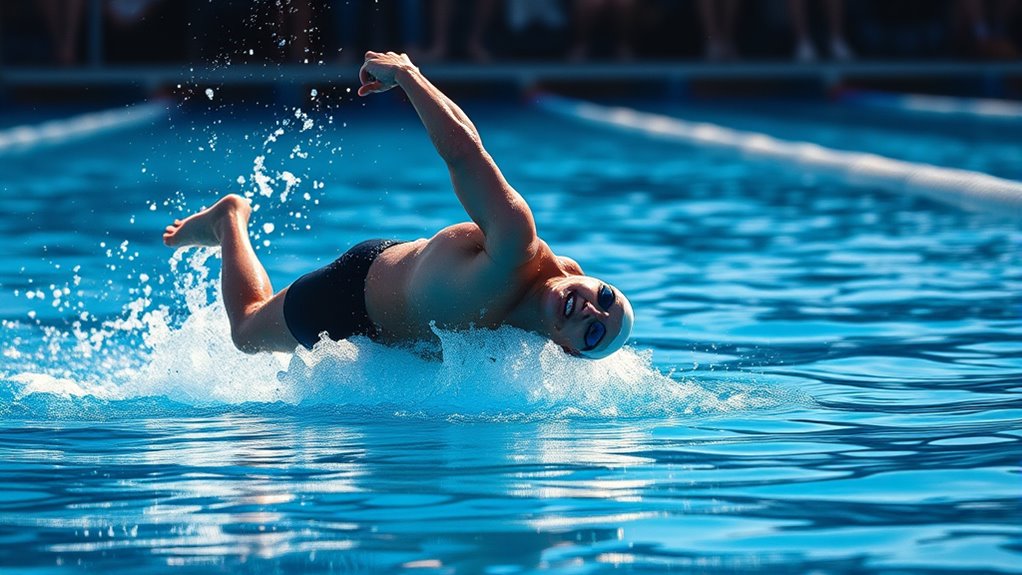

To perfect your flip turns, start your approach by timing your flip just 1-2 strokes from the wall. Keep your body tight and legs together during the flip to minimize drag. After you rotate fully underwater, push off the wall explosively with streamlined body alignment. Focus on maintaining speed and distance while you glide. Regular practice will enhance your technique, making your turns sharper and faster. There’s much more to explore on mastering these skills!
Key Takeaways
- Initiate the flip 1-2 strokes from the wall, focusing on timing and swim speed for a smooth transition.
- Keep legs together and body tight during the flip to minimize drag and enhance rotation efficiency.
- Position feet firmly against the wall after the flip for a strong, explosive push-off to maximize momentum.
- Immediately achieve a streamlined position post-push-off to generate maximum underwater distance.
- Regularly practice both flips and push-offs to build muscle memory and improve overall turn efficiency.
Mastering flip turn techniques can substantially enhance your swimming performance. When you nail the flip turn, you elevate your speed and efficiency, making your training sessions and races more effective. The key elements of a successful flip turn involve mastering the underwater flips and executing precise wall push-offs. Let’s break down how you can refine these aspects, ensuring you gain every possible advantage in the pool.
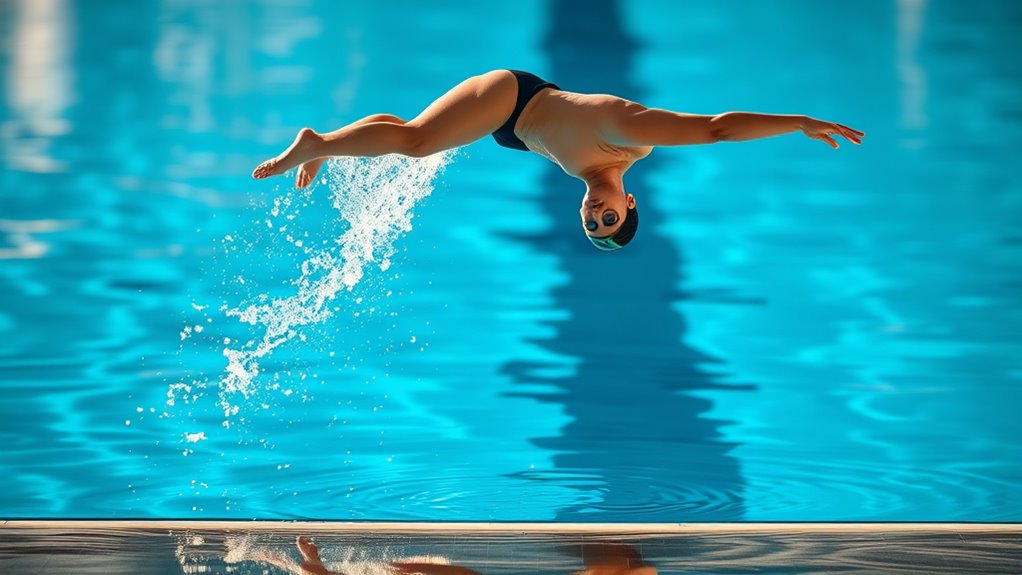
To start, you want to practice your approach to the wall. As you swim towards it, keep an eye on your timing. You’ll need to initiate your flip when you’re about one to two strokes away from the wall. This timing’s vital; it allows you to execute a smooth rotation while maintaining your momentum. As you reach the wall, tuck your chin into your chest and flip your body. This maneuver should feel fluid rather than forced. The goal is to complete a full rotation underwater, allowing you to streamline your body as you push off the wall.
Practice your approach to the wall, timing your flip perfectly for a smooth, efficient turn.
When it comes to the underwater flips, focus on keeping your legs together and your body tight. You want to minimize drag while you’re flipping. If your legs are spread apart, it will slow you down. So, practice your flips in a controlled environment, perhaps during warm-ups, until you feel comfortable and balanced. The more you practice, the more natural it’ll feel, allowing you to execute the flip efficiently during races.
After the flip, the next critical step is the wall push-off. This part of the turn is just as important as the flip itself. As you come out of the flip, position your feet against the wall and explode off it. Your legs should be strong and engaged. The push-off should be quick and powerful, propelling you into a streamlined position. You want to maximize your distance underwater before surfacing. This is where you can gain precious time over your competitors, so practice your push-offs regularly. Additionally, focusing on your high refresh rates can enhance your overall training effectiveness, allowing you to adapt quickly during practice sessions.

Action Camera 5K 30FPS Waterproof Camera Underwater 131FT with EIS WiFi App Remote Control 64GB Card 170° Wide Angle Sports Helmet Bike Video Black
Stunning 5K30FPS Video & 30MP Image – Ultra HD Action Camera 4K Experience: Capture crystal-clear visuals with 5K30FPS...
As an affiliate, we earn on qualifying purchases.
Frequently Asked Questions
How Can I Overcome Fear of Flip Turns?
To overcome your fear of flip turns, focus on mental preparation and gradual exposure. Start by visualizing yourself executing the turn confidently. Then, practice in shallow water where you feel safe, gradually increasing your comfort level. Break the flip turn into smaller steps, mastering each one before moving on. With consistent practice and positive reinforcement, you’ll build confidence and reduce anxiety, making flip turns feel like a natural part of your swimming routine.
What Are Common Mistakes During Flip Turns?
Common mistakes during flip turns often stem from technique errors and timing issues. You might be entering the turn too late or not tucking tightly enough, which can slow you down. Additionally, failing to push off the wall with enough force can hinder your speed. Pay attention to your body position and practice your timing to make certain a smoother, more efficient flip turn that maximizes your momentum in the water.
Should I Practice Flip Turns in Shallow Water?
Practicing flip turns in a more forgiving environment, like shallow water, can be quite beneficial. It allows you to focus on your technique without the fear of deeper water. However, always prioritize safety; make sure you’re comfortable and can stand up if needed. As you gain confidence and refine your skills, gradually shift to deeper water where you can truly enhance your flip turn performance. Enjoy the process and keep improving!
How Do Flip Turns Affect Breathing Techniques?
Flip turns can substantially enhance your breathing techniques in swimming. By mastering the timing of your breath control during the turn, you’ll find it easier to streamline your movements. As you rotate, inhale quickly before your head re-enters the water, allowing for a smoother shift. Practicing this will help you learn when to breathe efficiently, ensuring you maintain speed and minimize drag, which ultimately improves your overall performance in the pool.
Can Flip Turns Improve My Overall Swim Speed?
Yes, flip turns can substantially improve your overall swim speed. Studies show that swimmers can save up to 0.5 seconds per flip turn. By practicing drill variations, you’ll enhance your timing improvements, which translate into faster transitions in the water. Mastering these turns not only keeps your momentum but also helps you maintain a streamlined position, reducing drag. So, perfect those flip turns, and watch your swim speed soar!

Handheld GPS for Hiking, Rugged and Waterproof Handheld GPS Navigator, 3.2" Sunlight Readable Screen, Compact Satellite Handheld GPS with USA Topo Map, Multi-GNSS Support, Extra Battery Life
Excellent Satellite Support: Access Multi-GNSS navigation satellite systems (GPS+GALILEO+BEIDOU+QZSS) for improved position accuracy,location precision withih 5 ft, allows...
As an affiliate, we earn on qualifying purchases.
Conclusion
Perfecting your flip turns can truly transform your swim, making you feel like a dolphin gliding through the water. By mastering the techniques we’ve discussed, you’ll shave precious seconds off your time, leaving competitors in your wake. Remember, practice makes perfect, so dedicate time to refine your push-offs and turns. Soon, you’ll be executing flips with the finesse of an Olympic athlete, propelling yourself into the next level of your swimming journey!

Garmin 010-02258-10 GPSMAP 64sx, Handheld GPS with Altimeter and Compass, Preloaded with TopoActive Maps, Black/Tan
Rugged and water-resistant design with button operation and a 2. 6” sunlight-readable color display
As an affiliate, we earn on qualifying purchases.

Garmin 010-02256-00 eTrex 22x, Rugged Handheld GPS Navigator, Black/Navy
Explore confidently with the reliable handheld GPS
As an affiliate, we earn on qualifying purchases.