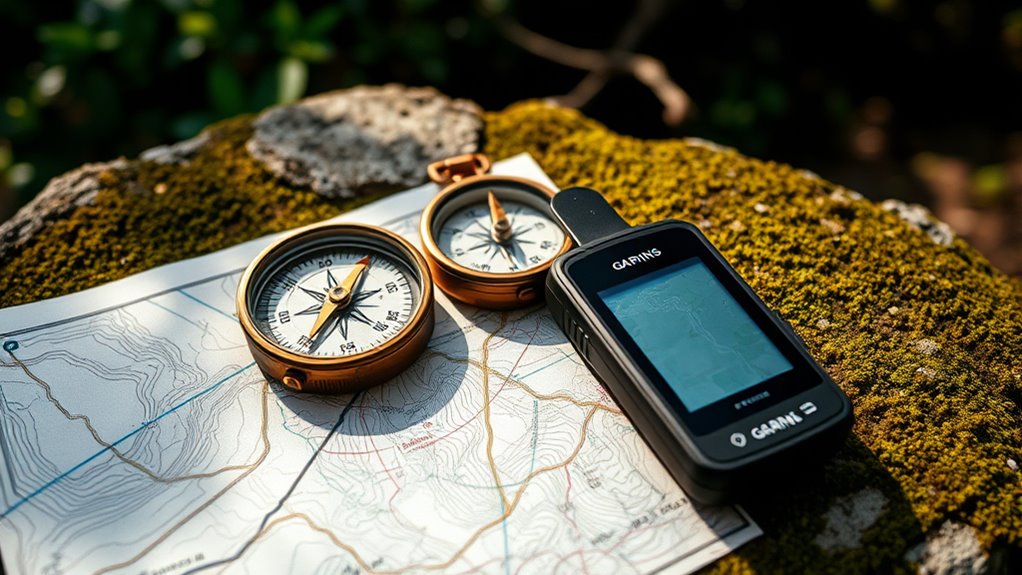

To guarantee reliable navigation, combining GPS and a compass is essential. GPS offers precise location data and real-time route updates, but signals can be blocked by obstacles or environmental interference. A compass, on the other hand, provides a dependable backup by pointing towards magnetic north without relying on satellites. Using both tools together enhances accuracy and safety, especially in challenging environments—continue exploring to see how mastering both can keep you oriented no matter what.
Key Takeaways
- Combining GPS and compass provides complementary navigation, ensuring accuracy when one system fails or is obstructed.
- Use GPS for detailed positioning and route planning, and rely on a compass as a reliable backup in signal-degraded environments.
- Cross-verify location data from GPS with compass readings to detect errors and enhance situational awareness.
- Regularly calibrate the compass to account for magnetic interference and local magnetic variations.
- Practicing integrated use of both tools prepares navigators for diverse conditions and improves overall navigation reliability.

When it comes to navigation, choosing between GPS and a compass depends on your needs and circumstances. If you’re relying on GPS, you’ll appreciate its satellite accuracy, which allows you to pinpoint your location with remarkable precision. Modern GPS devices use signals from multiple satellites orbiting the Earth, providing real-time data that can guide you through unfamiliar terrain or dense urban environments. However, this reliance comes with a caveat: satellite signals can be blocked or degraded by obstacles such as tall buildings, dense forests, or even heavy cloud cover. When this happens, your GPS may lose accuracy or cease to function altogether, leaving you without reliable navigation.
GPS offers precise location data but can be blocked by obstacles, making a compass a reliable backup in challenging environments.
In contrast, a compass offers a straightforward, mechanical form of direction-finding that isn’t dependent on satellites. It works by aligning with Earth’s magnetic field, pointing toward magnetic north. This makes it a highly dependable backup when GPS signals are compromised. Yet, a compass isn’t without its challenges. Magnetic interference from nearby metal objects, electronic devices, or geological formations can distort the compass needle, leading to inaccurate readings. You need to be aware of potential sources of magnetic interference around you—such as vehicles, power lines, or certain mineral deposits—and adjust your navigation accordingly. Proper calibration and understanding local magnetic anomalies help ensure your compass remains a trustworthy tool.
Both navigation methods excel in different situations, making redundancy a smart strategy. GPS can quickly provide detailed positioning, route planning, and even real-time updates, but it’s vulnerable to technological failures and environmental factors. Meanwhile, a compass is simple, reliable, and requires no power, making it invaluable in remote or power-outage scenarios. Combining these tools means you can cross-verify your position; if your GPS signal drops or becomes unreliable, you can fall back on your compass to maintain your bearings. Conversely, the GPS can help you confirm a rough direction when magnetic interference muddles your compass readings.
Ultimately, your choice hinges on your specific needs, terrain, and the environment you’ll navigate. Relying solely on one method leaves you exposed to potential failures, so practicing how to use both effectively ensures you’re prepared for any situation. Whether you’re hiking, sailing, or exploring unknown areas, integrating GPS with traditional navigation tools like a compass provides a robust strategy that maximizes accuracy and safety while minimizing risk. Additionally, understanding the value of home security systems can be applied to personal safety when exploring unfamiliar areas, emphasizing the importance of redundancy and preparedness in all aspects of navigation and security.
Top picks for "compas navigational redundancy"
Open Amazon search results for this keyword.
As an affiliate, we earn on qualifying purchases.
Frequently Asked Questions
How Do Magnetic Declinations Affect Compass Accuracy?
Magnetic declination impacts your compass accuracy because it’s the angle between magnetic north and true north, known as magnetic variation. Without proper declination correction, you might misjudge your direction. To stay accurate, you need to account for magnetic variation specific to your location. Regularly check maps or declination charts, and apply declination correction to your compass readings, ensuring your navigation remains precise despite magnetic declination’s influence.
Can GPS Signals Be Jammed or Blocked?
You should know that GPS signals can be jammed or blocked due to signal interference, which can disrupt your navigation. Common causes include intentional jamming or environmental factors like tall buildings or dense forests. Legal restrictions limit the use of jamming devices, but they still pose a risk. Relying solely on GPS isn’t foolproof; having a compass as a backup guarantees you stay on course even when signals are compromised.
What Are the Best Backup Strategies if Both Fail?
When both systems fall silent like a ship lost in fog, you need reliable backup plans. Think of alternative navigation as your lifeboat—crucial for survival skills. Carrying a detailed map, learning celestial navigation, and understanding terrain features act as your compass in the storm. By honing these skills, you create a safety net, ensuring you stay on course even when electronic signals vanish, turning uncertainty into your advantage.
How Does Terrain Impact Compass Navigation?
Terrain features and magnetic interference considerably impact compass navigation. You’ll find that magnetic interference from metal or electronic devices can distort your compass readings, making navigation tricky. Additionally, terrain features like dense forests, mountains, or valleys can obstruct your line of sight to celestial cues or landmarks, reducing your ability to orient yourself accurately. To stay on course, always consider these factors, and use terrain features to your advantage when possible.
Are There Any Legal Considerations for GPS Usage?
Did you know that over 60% of countries have specific laws regulating GPS use? When you use GPS devices, you need to consider legal compliance and privacy concerns. Some regions restrict or monitor GPS tracking, especially for commercial purposes. Always check local regulations to avoid legal issues. Respect privacy laws, and ensure your GPS use aligns with legal standards to stay safe and compliant while steering.
Conclusion
In the end, relying solely on one navigational tool is like putting all your eggs in one basket. GPS offers convenience and accuracy, but a compass provides essential backup when technology fails. By combining both, you cover your bases and stay on course no matter what. Remember, it’s always better to be safe than sorry—having redundancy keeps you from getting lost when one system lets you down. Stay prepared, and you’ll never be off track.