Thanksgiving hosts comparing kitchen tools are usually deciding where extra spending will make the day easier. An essential kit built around a sharp chef’s knife, instant-read thermometer, sturdy sheet pans, reliable roasting pan, and basic serving utensils covers the jobs most dinners require. A premium kit may add heavier cookware, a probe thermometer, a food processor, a carving set, and specialty serving pieces. The main difference is breadth and convenience, not whether the meal can be made: the essentials handle the core work, while upgrades can save time or improve control when several dishes compete for attention. Choose the essential kit for occasional hosting or a tight budget; choose premium tools if you cook for a crowd every year and will use them beyond Thanksgiving.

Get sports gear delivered free with Prime
- Fast, free delivery on millions of items
- Prime Video, Amazon Music and more included
- Member-only deals all year

30 ml Heat-Resistant Turkey Baster with Cleaning Brush
- ✔ Capacity: 30 ml (1 oz)
- ✔ Material: Food-grade, heat-resistant AS; silicone bulb
- ✔ Maximum temperature: 100°C (212°F)
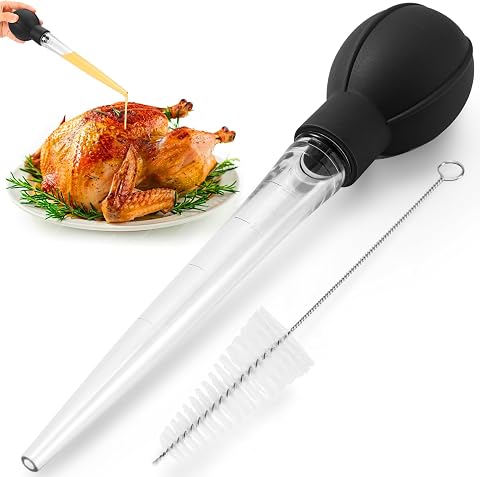
OLESBUR Turkey Baster with Cleaning Brush, Black
- ✔ Capacity: 28 ml (1 oz)
- ✔ Material: Food-grade AS with silicone bulb
- ✔ Heat resistance: Up to 100°C (212°F)

R&M Thankful Silicone Spatula with Beechwood Handle
- ✔ Length: 12 inches
- ✔ Width: 1.38 inches
- ✔ Head material: Silicone
At a Glance
| Criteria | Essential Thanksgiving Kitchen Tool Kit | Premium Thanksgiving Kitchen Tool Kit | Winner |
|---|---|---|---|
| Core cooking coverage | Covers roasting, chopping, baking, and basic serving with a small set of versatile tools | Adds specialized tools and appliances that can reduce work across more recipes | Depends |
| Temperature control | A handheld instant-read thermometer gives quick checks but needs attention during cooking | A leave-in probe can monitor the roast while the host handles other tasks | B |
| Prep speed | Manual chopping and mixing take longer but avoid buying appliances for one meal | Food processor or stand mixer speeds repeated prep, especially for larger batches | B |
| Capacity and durability | Standard cookware and pans are sufficient for a typical turkey and side dishes when sized carefully | Heavier or larger cookware can handle frequent use and bigger meals, if it fits the oven and storage | B |
| Serving and carving | Basic carving knife and serving spoons handle the meal | Dedicated carving and serving pieces can improve control and presentation | B |
| Storage and upkeep | Fewer pieces take less cabinet space and are easier to clean | More pieces require more storage, cleaning, and maintenance | A |
| Cost and value | Lower upfront cost; strong value for occasional hosts | Higher upfront cost; value improves with frequent use | A |
30 ml Heat-Resistant Turkey Baster with Cleaning Brush
When a roast needs periodic basting and we also want a way to transfer a little sauce, this model makes the most straightforward case. Its 30 ml capacity is marginally greater than the OLESBUR’s 28 ml, and the clear milliliter and ounce markings help us portion liquid without guessing. That difference is small, but in a tool that holds only about an ounce, every bit of capacity helps reduce the number of refill cycles.The textured silicone bulb is intended to improve grip during repeated squeezes, and the food-grade AS body is rated to 100°C (212°F). Like the OLESBUR, it includes a brush that stores inside the tube and can go in the dishwasher. Those shared conveniences make cleanup and storage easier to plan for after a large meal. The listed weight is 1.44 ounces, considerably lighter than the OLESBUR’s stated 3.84 ounces, though product weights alone do not establish which one will feel better in hand.Our reason for ranking it first is the practical combination of slightly more capacity and clearly specified dual-unit markings. It can also transfer sauces or marinades, but its narrow tube and small reservoir are better for modest amounts than for filling a gravy boat or handling a full pan’s juices. Compared with the R&M spatula, this baster addresses roasting directly; compared with the OLESBUR, it has only a modest edge. Frequent refilling remains the central limitation, and the 100°C ceiling should guide how we handle hot liquids.
Pros:
- 30 ml capacity is slightly larger than the OLESBUR model’s 28 ml.
- Clear milliliter and ounce markings support measured portions.
- Textured silicone bulb is designed to provide a non-slip grip.
- Dishwasher-safe and includes a brush that stores inside the tube.
Cons:
- One-ounce capacity still means repeated refilling for a large roast.
- Maximum stated temperature is 100°C (212°F).
Best for: Hosts who want a compact, marked baster for periodic turkey basting and small sauce transfers, with dishwasher-safe cleanup.
Not ideal for: Cooks who need to move large quantities of liquid quickly or want a baster rated above 100°C (212°F).
Bottom line: We’d choose this as the lineup’s most practical baster for measured, small-volume basting, provided its modest capacity suits the job.
“We’d choose this as the lineup’s most practical baster for measured, small-volume basting, provided its modest capacity suits the job.”
OLESBUR Turkey Baster with Cleaning Brush, Black
The OLESBUR is a close match for the top-ranked baster and makes sense when we want a simple tool for drawing up pan juices, applying marinades, or removing a little excess grease. It holds 28 ml (1 oz), just two milliliters less than the 30 ml competitor, and its dual ml and oz scales support the same kind of portion control. For ordinary spot basting, that capacity gap is unlikely to define the decision; for many passes over a large turkey, both tools will need frequent refills.Its food-grade AS construction and silicone bulb carry a stated 100°C (212°F) heat limit, matching the other baster. The bulb is described as non-slip, and the package includes a brush that fits inside the suction tube for storage. Dishwasher-safe cleanup is also a useful hosting detail: it means the baster’s narrow interior has both a purpose-made brush and a stated machine-washing option. These are practical similarities, so buyers should not expect a fundamentally different style of baster from the top pick.Where OLESBUR differs is mainly in its listed weight and dimensions: it is specified at 3.84 ounces and 11.73 inches long, versus 1.44 ounces and 11.1 inches for the 30 ml model. Those numbers may matter to buyers comparing storage or handling, though the supplied specifications do not explain why the weights differ. We rank it second because its capacity is fractionally smaller and it offers no clear functional advantage over the first-place option. Still, the integrated brush storage and dual scales make it a well-equipped choice for cooks who prefer this model’s listed form factor.
Pros:
- Dual ml and oz scales help portion basting liquid.
- Non-slip silicone bulb is designed for a secure grip.
- Brush fits inside the suction tube for storage.
- Dishwasher safe and rated for use up to 100°C (212°F).
Cons:
- Its 28 ml capacity is slightly smaller than the 30 ml alternative.
- Small reservoir may require repeated filling during a long roast.
- Stated heat resistance does not exceed 100°C (212°F).
Best for: Hosts who want a straightforward, dual-marked baster with a textured bulb, dishwasher-safe care, and a brush stored in the tube.
Not ideal for: Anyone seeking a larger reservoir for fewer refills or a tool with a higher stated heat tolerance.
Bottom line: We’d pick the OLESBUR when its listed size and weight suit our storage or handling preferences, while recognizing that it performs much like the slightly larger baster.
“We’d pick the OLESBUR when its listed size and weight suit our storage or handling preferences, while recognizing that it performs much like the slightly larger baster.”
R&M Thankful Silicone Spatula with Beechwood Handle
This spatula earns its place by covering a different part of Thanksgiving cooking: the mixing and finishing work that happens around the roast. Its flexible silicone head is meant to scrape bowls, pans, and jars, while also supporting folding and frosting. That range makes it more useful for batter, mashed sides, and dessert prep than either baster, which is designed for transferring liquid rather than clearing a bowl.At 12 inches long, it offers a familiar reach for countertop mixing, and the silicone head is listed as suitable for nonstick cookware. The white head carries a “Thankful” fall design with colorful maple leaves, so it can contribute a seasonal touch during prep or serving. Compared with the two black basters, this is the more decorative choice and the only one in the group intended for scraping and folding. The tradeoff is that the beechwood handle needs more attentive care: it should be hand washed and dried thoroughly rather than placed in the dishwasher.We rank it third overall because it supports a narrower set of hosting tasks than a baster when the central meal includes a roasted turkey. That ranking does not make it less useful for a baker or anyone preparing sides and desserts; it simply fills a different role. Buyers should also expect one spatula, with no extra components or storage accessories. Choose it for its flexible head and seasonal design, and skip it if your main need is roast basting or if dishwasher-only cleanup is important. Its usefulness depends on the cooking jobs we do most, rather than on its holiday decoration alone.
Pros:
- Flexible silicone head is designed to scrape bowls, pans, and jars.
- Suitable for use with nonstick cookware.
- 12-inch length supports mixing, folding, and frosting tasks.
- “Thankful” design and maple leaves add seasonal character.
Cons:
- Hand washing is recommended.
- Beechwood handle should be dried thoroughly before storage.
- Does not serve the basting and liquid-transfer role of either baster.
Best for: Hosts who bake or prepare sides and want a flexible scraper for mixing, folding, and frosting with a fall-themed design.
Not ideal for: Cooks whose main need is turkey basting, or anyone who wants a fully dishwasher-safe tool with no wood-handle care.
Bottom line: We’d choose this spatula for seasonal baking and bowl-scraping, while treating its wood-handle care and specialized role as part of the decision.
“We’d choose this spatula for seasonal baking and bowl-scraping, while treating its wood-handle care and specialized role as part of the decision.”
As an Amazon Associate we earn from qualifying purchases.
Key Differences
The essential kit wins on focus. A thermometer, dependable knife, roasting pan, sheet pan, cutting board, and a few sturdy utensils solve the most common bottlenecks without filling drawers with tools used once a year. For a host preparing a turkey and familiar sides, careful timing and a clear prep plan usually matter more than specialty gadgets. The tradeoff is hands-on work: checking temperature manually, chopping ingredients in batches, and coordinating oven space with ordinary pans.
The premium kit buys convenience and repeat use, especially through a leave-in thermometer, higher-capacity cookware, or appliances that reduce prep time. These additions can be meaningful when cooking for many guests or making Thanksgiving food from scratch, but they do not guarantee a better dinner. They cost more, take storage, and need cleaning. A premium carving set or decorative serving pieces have less practical impact than a reliable thermometer or pan sized for the meal.
Value depends on how often the tools leave the cupboard. For a once-a-year host, buy the essentials and upgrade only a specific weak point. For someone who regularly cooks large meals, a premium tool that gets used weekly can justify its price. Avoid buying a full premium set simply because the holiday feels high stakes; buy the tools that address a real constraint.
Detailed Comparison
Core cooking coverage (moderate difference)
The essential kit wins for a standard menu because its knife, thermometer, roasting pan, and sheet pans cover the central jobs. The difference is minor if the premium set’s extras are rarely used; it becomes moderate when the menu includes many scratch-made dishes that need specialized equipment. Premium tools broaden what is convenient, but the basics remain sufficient for many households.
The premium kit wins by a moderate margin when it includes a reliable leave-in probe. It can alert the cook as the roast approaches its target while other tasks continue. An instant-read thermometer in the essential kit is still a sound choice and can check several spots, but it requires the host to pause and measure manually. Whichever option you choose, use a thermometer rather than relying on appearance alone.
The premium kit wins for large batches if it includes a food processor or mixer the host knows how to use. It can reduce repetitive chopping or mixing, which matters when several sides are made from scratch. The gap is minor for a small menu or a cook who already preps efficiently with a knife and bowl. Appliances add setup and cleanup, so they save time only when the task suits them.
The premium kit has a moderate advantage when it offers sturdy cookware sized for frequent large meals. A stable roasting pan and suitable sheet pans can make handling heavy food easier and stand up to repeated use. Yet capacity must match the oven, burners, and storage available; oversized gear can be a poor fit. Check dimensions and construction before paying more.
The premium kit wins by a minor margin if it includes a well-balanced carving knife and fork or serving pieces that solve a real need. Dedicated tools can provide better control for a large bird, but a sharp knife and ordinary serving spoons can do the job. Decorative pieces add presentation more than cooking performance, so prioritize function over a matching set.
Storage and upkeep (Essential Thanksgiving Kitchen Tool Kit wins — moderate)
The essential kit wins by a moderate margin because fewer tools mean less cabinet space, washing, and maintenance. Premium appliances and specialty cookware can earn their space through frequent use, but they complicate cleanup after an already busy meal. If kitchen storage is limited, choose compact multiuse tools and borrow or rent a rarely needed item where practical.
Cost and value (Essential Thanksgiving Kitchen Tool Kit wins — major)
The essential kit wins for most occasional hosts: its lower cost leaves room in the budget for ingredients, and the core tools remain useful. The premium kit earns its higher price when its upgrades see regular use or remove a repeated bottleneck. The gap is major for a buyer who would use an appliance only once, but smaller for a frequent cook who can spread its cost across many meals.
Essential Thanksgiving Kitchen Tool Kit: Pros and Cons
Pros:
- Lower upfront cost and fewer unnecessary purchases
- Core tools work for Thanksgiving and everyday cooking
- Takes less storage and is simpler to clean
Cons:
- More hands-on temperature checks and prep
- May lack capacity or specialized tools for a very large menu
- Standard cookware may wear faster with frequent heavy use
Pros:
- Convenience upgrades can reduce monitoring and repetitive prep
- More likely to include durable, higher-capacity cookware
- Useful for hosts who regularly cook large meals
Cons:
- Higher upfront cost can exceed the benefit for occasional use
- Extra appliances and pieces need storage and cleaning
- Specialty serving tools may add little to cooking results
Who Should Choose What
Choose Essential Thanksgiving Kitchen Tool Kit if:
- You host Thanksgiving occasionally and already have basic cookware
- Your kitchen has limited storage or your budget is focused on food and essentials
- You are comfortable chopping by hand and checking roast temperature with an instant-read thermometer
Choose Premium Thanksgiving Kitchen Tool Kit if:
- You cook for a large group several times a year
- You will use the processor, mixer, probe thermometer, or sturdy cookware regularly
- A specific prep or capacity problem reliably makes holiday cooking harder
Skip both if: You already own reliable core tools; replace only a damaged or unsuitable item instead of buying another kit.
Value for Money
Paying more is worthwhile when the added tool gets frequent use or directly addresses a recurring problem. A leave-in thermometer can make a busy cooking schedule easier to manage, while a food processor can repay its cost for a household that regularly makes large batches. By contrast, a premium carving set or specialty gadget used for one dinner is hard to justify on value alone. The essential kit is the better value for most once-a-year hosts; premium is better value for frequent cooks who will use the upgrades throughout the year.
Final Verdict
For most Thanksgiving hosts, choose the Essential Thanksgiving Kitchen Tool Kit. A sharp knife, reliable thermometer, suitable roasting pan, sheet pans, and basic utensils cover the work that most affects the meal without requiring a large purchase or extra storage. Choose the Premium Thanksgiving Kitchen Tool Kit if you regularly cook for a crowd and can name upgrades you will use beyond the holiday. The deciding factor is repeat use: pay more for tools that remove a real bottleneck across many meals, and skip a full kit if your current essentials already do the job.
Frequently Asked Questions
What kitchen tool is most useful for Thanksgiving turkey?
A reliable instant-read thermometer is useful for checking doneness at the thickest areas. A leave-in probe adds convenience by tracking temperature while you work on other dishes, but either approach is more dependable than judging by color or cooking time alone.
Is a food processor worth buying just for Thanksgiving?
Usually not if it will sit unused afterward. It can save time on large batches of vegetables, breadcrumbs, or dough, but a knife and mixing bowl are enough for many menus. Buy one when it also suits your regular cooking.
Should I buy a premium roasting pan?
Pay more when you roast often, need a larger capacity, or want sturdier construction for repeated use. For occasional hosting, a well-sized standard pan can be adequate. Check that it fits your oven and is manageable when loaded.
Can I host Thanksgiving with basic kitchen tools?
Yes. Plan the menu around your oven space and cookware, prepare ingredients ahead, and use a sharp knife and thermometer. Specialty appliances make some tasks faster, but they are not a requirement for a complete meal.